An exchange-rate movement changes the domestic-currency equivalent of a foreign-currency price. The effect on a consumer price or a firm's final selling price is less immediate. Existing inventories, hedges, invoicing terms, freight, domestic distribution costs, taxes, and margins can alter the timing and extent of transmission.
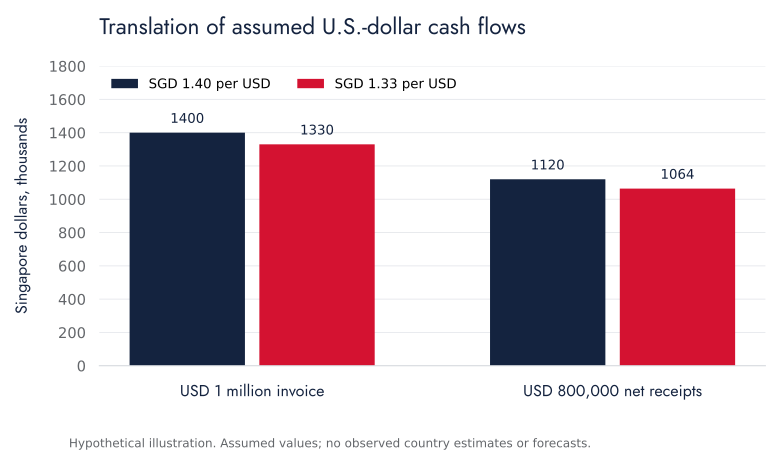
A hypothetical importer illustrates the distinction. Suppose it owes US$1 million for goods. At S$1.40 per U.S. dollar, the unhedged invoice costs S$1.40 million. At S$1.33, the same invoice costs S$1.33 million, a reduction of S$70,000, or 5 percent. These assumed bilateral rates are not a forecast and do not represent a 5 percent movement in the S$NEER basket.
If the importer has already purchased the required dollars at a contracted rate, the immediate cash cost of that invoice follows the contract. If the supplier raises the dollar price, the currency benefit may be partly offset. If the final retail price includes substantial domestic costs, a 5 percent reduction in the imported invoice cost will not imply a 5 percent reduction in the retail price.
An assessment of inflation transmission thus requires an exposure map: what is priced abroad, when the foreign price is fixed, when the exchange rate is fixed, and when the domestic selling price can be changed. These questions identify the mechanisms through which exchange-rate policy can influence prices without assuming uniform pass-through across products.
The policy horizon also differs from the life of an individual invoice. A medium-term monetary assessment considers expected cost and demand conditions beyond a single transaction. A one-month fall in an imported price cannot establish the eventual inflation effect of a policy setting, particularly when wages, rents, and other domestic costs are changing independently.