A public-debt ratio places an outstanding stock of obligations against the income produced during a period. It provides a common scale for analysis, but does not specify the government's repayment schedule, available cash, or capacity to raise revenue. Two governments with identical ratios can face substantially different financing conditions.
Reading the ratio requires three decisions: which public institutions are covered, which liabilities are included, and which GDP period supplies the denominator. Those choices precede any assessment of whether the debt burden is rising or manageable.
Establish the perimeter
Central government, general government, and the public sector are different reporting boundaries. A central-government series can omit borrowing by other levels of government. A broader public-sector measure may include public corporations. Adding published liabilities across institutions without removing claims between them can double count obligations.
Gross debt and net debt also answer different questions. Gross debt records covered debt liabilities before deducting corresponding financial assets. Net debt subtracts financial assets in debt instruments; it is not ordinarily gross debt less every asset the state owns. The IMF's WEO methodological FAQ sets out these distinctions and notes the importance of consolidation and country-specific metadata.
An asset deduction nevertheless requires interpretation. A long-term loan to another entity may reduce measured net debt while providing little cash for a bond redemption next month. An equity holding or a public road may be valuable without qualifying as a deduction under the relevant net-debt definition. The ratio should retain its published definition; a separate discussion should assess asset liquidity and availability.
Debt valuation deserves similar attention. A bond's market price can change when yields move, even if its promised principal does not. Comparing one government's nominal-value measure with another's market-value measure can introduce a difference unrelated to new borrowing. A sound comparison states the valuation basis alongside institutional and instrument coverage.
Why the ratio changes
For a simplified government whose debt is entirely denominated in domestic currency, define:
- dt−1: the previous year-end debt stock divided by previous-year nominal GDP;
- i: the effective nominal interest rate on that opening debt;
- g: nominal GDP growth;
- p: the primary surplus divided by current-year GDP;
- a: other net additions to debt divided by current-year GDP.
Under these assumptions, the accounting relation is:
dt=1+g1+idt−1−p+a.A positive primary surplus reduces the ratio; a primary deficit makes p negative. The term a reconciles debt changes not captured by the simplified interest and primary-balance terms. Its classification must be consistent with the fiscal accounts. The IMF's guide to public-debt projections develops a fuller treatment, including foreign-currency obligations and valuation effects. The equation here is a restricted illustration, not that complete model.
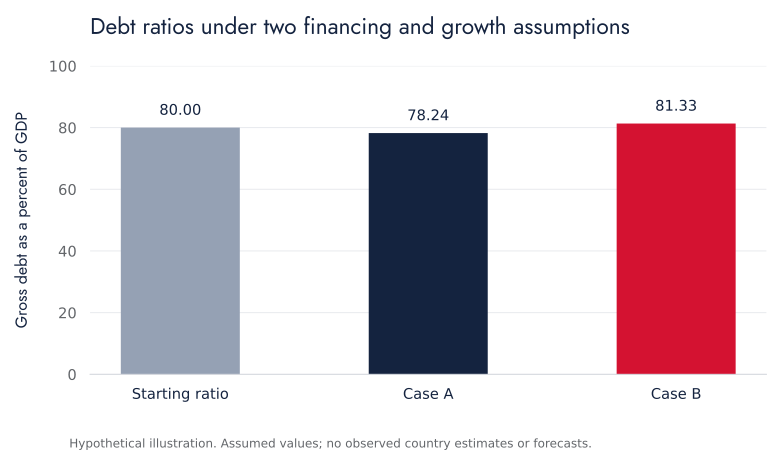
Assume, hypothetically, that opening debt is 80 and nominal GDP is 100. With an effective interest rate of 4 percent, nominal GDP growth of 5 percent, a primary surplus equal to 1 percent of current GDP, and no other adjustment, year-end debt becomes 82.15 and GDP becomes 105. The debt ratio falls from 80 percent to approximately 78.24 percent even though the debt stock increases.
Now change the interest rate to 6 percent and nominal growth to 3 percent, retaining the same opening position and primary-surplus ratio. Debt reaches 83.77 against GDP of 103. The ratio rises to approximately 81.33 percent. These are separate hypothetical cases. They do not estimate the response of a particular government's debt to a change in policy.
The exercise shows why a primary surplus alone does not establish that the ratio will fall. It also shows why the effective interest rate matters. The yield on a newly issued bond is not automatically the rate paid on the entire stock. Repricing depends on maturities, floating-rate terms, refinancing, and other contractual features.
Debt service and refinancing
A declining ratio does not eliminate a near-term funding requirement. In the first hypothetical case, suppose principal of 20 matures during the year. Interest is 3.20 and the primary surplus is 1.05. With no other transactions or use of cash balances, gross financing needs are 20 + 3.20 − 1.05 = 22.15. The government must arrange that financing while the debt ratio is falling.
This distinction directs attention to the maturity profile, cash reserves, creditor composition, and terms of borrowing. Foreign-currency debt adds exposure to movements in the domestic-currency value of payments. A guarantee can create a future fiscal demand even when it is outside the measured debt stock before a call occurs. These exposures require separate reporting rather than silent additions to a headline ratio.
Nominal growth also needs decomposition. Faster real output can expand the tax base. Higher prices can enlarge nominal GDP while affecting interest costs, indexed obligations, expenditure needs, and the exchange rate. The equation records their combined arithmetic; it does not establish that inflation is a reliable means of reducing fiscal pressure.